Business Plan Outline and Templates for Startups & Entrepreneurs
Create a powerful business plan outline with real templates and examples. Learn what to include, how to structure it for investors, and how startups can build strategic clarity faster with AI.
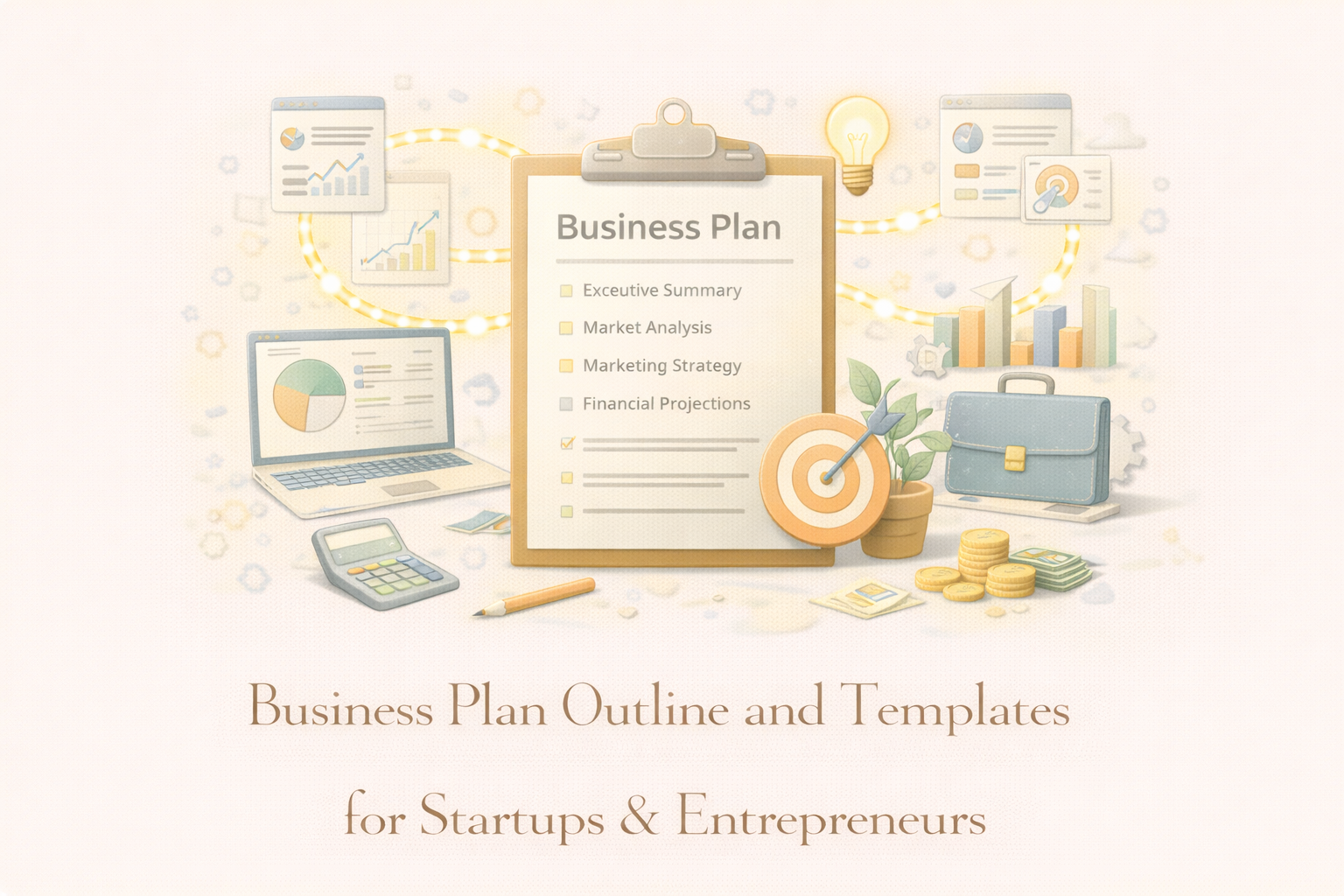
A business rarely fails because the founder lacked ambition. It fails because the strategy was never clearly structured.
Behind every successful startup—whether bootstrapped or venture-backed—there is a coherent logic connecting problem, solution, market, and execution. A business plan outline is the framework that forces that logic into place before significant capital, time, and reputation are invested.
For startups and entrepreneurs in 2026, clarity is more important than length. Investors expect structured thinking. Co-founders need alignment. Teams require direction. A well-crafted business plan outline transforms scattered ideas into an integrated strategy that can scale.
This guide walks through what a business plan outline truly is, why it matters, the different formats available, and what elements must be included to make it investor-ready and execution-focused.
What Is a Business Plan Outline?
A business plan outline is the structured blueprint of a company’s strategic narrative. It organizes the essential components of a business—vision, market opportunity, competitive landscape, operating model, and financial logic—into a coherent architecture before the full document is written.
It is not simply a table of contents. It is the strategic skeleton that determines:
- How your argument flows
- Whether your assumptions are defensible
- If your growth model makes sense
- Whether your positioning is differentiated
In practice, a business plan outline performs three critical functions.
First, it enforces logical consistency. If your target customer, pricing model, and go-to-market strategy do not align, the outline exposes that gap immediately.
Second, it clarifies decision hierarchy. Entrepreneurs often mix tactical details with strategic vision. An outline distinguishes what is core (problem, market, model) from what is operational (execution tactics).
Third, it creates communication discipline. Investors, advisors, and partners evaluate clarity as a proxy for execution capability. A strong outline signals strategic maturity.
In modern product-driven organizations, the business plan outline often acts as the foundational lifecycle document—informing roadmap decisions, launch strategies, and long-term growth planning.
Why You Need a Productive Business Plan Outline
A productive business plan outline is not about satisfying a template. It is about reducing strategic ambiguity.
Startups operate under extreme uncertainty. Without structure, founders often optimize for activity rather than direction. A business plan outline forces prioritization. It requires founders to define who the product is for, why it matters now, and how value will be captured sustainably.
It also prevents internal misalignment. Many startup conflicts stem not from personality differences, but from unspoken strategic disagreements. A written outline surfaces assumptions around pricing, funding strategy, growth expectations, and competitive positioning. If founders cannot align on the outline, scaling execution will amplify the disagreement.
From an investor perspective, a clear outline demonstrates disciplined thinking. Investors look for causal reasoning: how does the market opportunity justify the revenue projection? How does the product differentiation support defensibility? An outline makes these connections explicit before detailed financial modeling is introduced.
Finally, it reduces long-term drift. As companies grow, early assumptions fade from memory. A structured outline preserves strategic intent, allowing teams to revisit and refine decisions instead of rebuilding direction from scratch.
Types of Business Plan Outlines
Different business contexts require different levels of depth and structure. The right format depends on your stage, audience, and purpose.
Traditional Business Plan Outline
The traditional format is comprehensive and formal. It typically spans multiple sections including executive summary, company description, market analysis, product details, operations, financial projections, and risk assessment. This structure is often required for bank financing, institutional investors, and government programs. It emphasizes rigor, data, and defensibility.
This format works best when external stakeholders require structured validation and long-term planning clarity.
Lean Startup Outline
The lean version is streamlined and focused on hypothesis testing. Instead of exhaustive financial projections, it emphasizes problem validation, customer segments, value proposition, channels, revenue model, and key metrics.
This format is ideal for early-stage founders validating product-market fit. It prioritizes clarity and speed over formality.
One-Page Business Plan Outline
A one-page outline condenses the entire business model into a single structured framework. It typically includes vision, target customer, problem, solution, revenue model, competitive edge, and growth approach.
This format is powerful for founder alignment and strategic simplicity. It forces elimination of fluff and reveals whether the core idea holds together logically.
Internal Strategic Plan Outline
This version is often used by scaling startups. It connects long-term objectives to quarterly goals, resource allocation, and execution plans. While less investor-facing, it is critical for organizational alignment.
It bridges product lifecycle planning with operational accountability.
Grant or Accelerator-Focused Outline
This version adapts the structure to highlight impact, feasibility, innovation, and societal value. It often includes measurable outcomes and risk mitigation frameworks.
It is tailored to specific evaluation criteria rather than open-ended strategic storytelling.
What to Include in a Successful Business Plan Outline
While formats vary, high-quality outlines consistently include foundational elements that establish clarity and credibility.
Executive Summary
The executive summary encapsulates the essence of your company. It should articulate your mission, core offering, market opportunity, traction (if any), and strategic ambition. Although it appears first, it often synthesizes insights developed across the entire plan.
It must answer: Why does this business deserve attention now?
Problem Statement
This section defines the specific pain point your target audience experiences. Strong problem statements are concrete, measurable, and evidence-based. They describe friction in real terms—lost time, inefficiency, cost, dissatisfaction—rather than abstract dissatisfaction.
The sharper the problem definition, the stronger the opportunity justification.
Solution & Product Overview
Here you explain how your offering solves the identified problem. This includes core functionality, differentiation, and unique value. The focus should be on impact rather than features.
The solution must logically map back to the problem. If the connection is weak, the business case weakens accordingly.
Market Opportunity
A compelling business plan outline quantifies opportunity size and contextualizes timing. This includes total addressable market (TAM), serviceable segments, growth trends, and competitive landscape.
This section demonstrates that the opportunity is not only meaningful, but reachable with a realistic strategy.
Business Model
The business model explains how value becomes revenue. This includes pricing logic, revenue streams, cost structure, and scalability potential.
Investors and advisors pay particular attention to whether the economics align with growth ambitions.
Go-to-Market Strategy
This section describes how customers will be acquired and retained. It includes channel strategy, positioning, partnerships, and customer lifecycle considerations.
Execution clarity is essential. A vague marketing statement signals weak operational readiness.
Competitive Analysis
No business exists in isolation. A strong outline evaluates competitors honestly and identifies structural advantages. This includes differentiation, barriers to entry, and long-term defensibility.
Ignoring competition undermines credibility.
Operations Plan
Operational structure explains how the business functions internally. This includes team composition, workflow processes, technology infrastructure, and supply chain considerations where relevant.
Operational clarity supports scalability and execution confidence.
Financial Projections
Financial projections provide forward-looking visibility into revenue, costs, cash flow, and funding needs. They must align logically with the strategy presented earlier.
Overly optimistic or disconnected projections weaken trust. Consistency matters more than aggressiveness.
Building a Business Plan Outline Efficiently with Kuse
Modern entrepreneurs often struggle not with ideas, but with fragmentation. Research notes live in one tool, financial models in another, customer interviews elsewhere.
Instead of manually consolidating information, a structured AI-powered workflow can accelerate outline development.
By uploading research documents, competitive analysis notes, financial spreadsheets, and strategic discussions into a unified workspace, you can ask Kuse to synthesize them into a structured business plan outline.
For example:
“Create a structured business plan outline from these materials. Organize it into Executive Summary, Problem, Solution, Market Opportunity, Business Model, Go-to-Market Strategy, Competitive Analysis, Operations, and Financial Plan. Highlight assumptions and strategic risks.”
Kuse can generate multiple versions tailored to different audiences—investor-ready, lean startup, or internal strategy—while preserving contextual continuity across documents.
This transforms business planning from a manual drafting task into a strategic synthesis workflow.
Conclusion
A business plan outline is not administrative paperwork. It is strategic architecture.
It forces founders to think clearly before executing aggressively. It aligns teams before scaling complexity. It strengthens communication before fundraising conversations begin.
In the broader product lifecycle, it represents the origin point of structured decision-making. Companies that invest time in designing a strong outline reduce downstream confusion, rework, and misalignment.
Clarity scales. Ambiguity compounds.
A well-structured business plan outline ensures your growth is built on intention—not assumption.