What Is a Sprint Review and How to Make It Productive
What is a sprint review? Learn how to run productive sprint reviews, understand the difference from retrospectives, and improve alignment with practical templates and AI workflows.

In agile product teams, the sprint review is one of the most visible—and most misunderstood—ceremonies. Too often, it is reduced to a feature demo or a status update meeting. In reality, a sprint review is a strategic feedback checkpoint that connects execution to product direction.
Within a broader Product Lifecycle Management (PLM) system, sprint reviews play a critical role. They ensure that incremental work aligns with long-term product goals, customer needs, and roadmap priorities. When done well, sprint reviews reduce misalignment, accelerate learning, and strengthen cross-functional collaboration.
This guide explains what a sprint review really is, why it matters, how it differs from a sprint retrospective, and how to structure a high-impact sprint review—along with a modern workflow using AI tools like Kuse to make the process more effective.
What Is a Sprint Review?
A sprint review is an agile event held at the end of a sprint where the development team presents completed work to stakeholders and gathers feedback.
However, it is not simply a demo session. According to Scrum principles, the sprint review is a collaborative working session designed to inspect the increment and adapt the product backlog based on new insights.
The key elements of a sprint review include:
- Demonstrating the increment that meets the Definition of Done
- Discussing what was completed versus what was planned
- Gathering stakeholder feedback
- Reviewing product goals and roadmap alignment
- Identifying opportunities, risks, or shifts in direction
Unlike internal-only meetings, sprint reviews typically involve product owners, stakeholders, customers (when appropriate), leadership, and cross-functional partners.
In essence, a sprint review bridges tactical delivery and strategic intent.
Why Is a Sprint Review Important?
Sprint reviews are critical because they create structured learning loops.
First, they validate whether the team is building the right thing—not just building it correctly. Technical correctness is verified continuously during development. Strategic correctness is verified during sprint reviews.
Second, sprint reviews improve transparency. Stakeholders gain real visibility into product progress rather than relying on slide decks or summaries.
Third, they support adaptive planning. Agile teams operate under uncertainty. Sprint reviews allow teams to adjust priorities before small misalignments become large strategic failures.
Fourth, sprint reviews strengthen product lifecycle continuity. They connect sprint-level work to roadmap themes, product strategy, and long-term value creation.
Without effective sprint reviews, teams risk drifting away from user needs, over-investing in low-impact features, or failing to detect emerging risks early.
Sprint Review vs. Sprint Retrospective
Although often confused, sprint reviews and sprint retrospectives serve very different purposes.
A sprint review is outward-facing. It focuses on product outcomes and business value. It invites feedback from customers, stakeholders, and leadership to ensure alignment with strategy.
A sprint retrospective is inward-facing. It is a safe space for the team to reflect on collaboration, communication, technical practices, and workflow efficiency.
Confusing these two events can undermine both. If sprint reviews become process complaint sessions, stakeholders disengage. If retrospectives turn into product demos, teams miss improvement opportunities.
Clear separation preserves the effectiveness of both ceremonies.
How to Run a Successful Sprint Review
A sprint review becomes powerful not because it follows Scrum formally, but because it creates structured visibility between execution and strategy. Below is a more detailed breakdown of how to design and facilitate a sprint review that actually drives product progress.
Step 1: Prepare the Increment
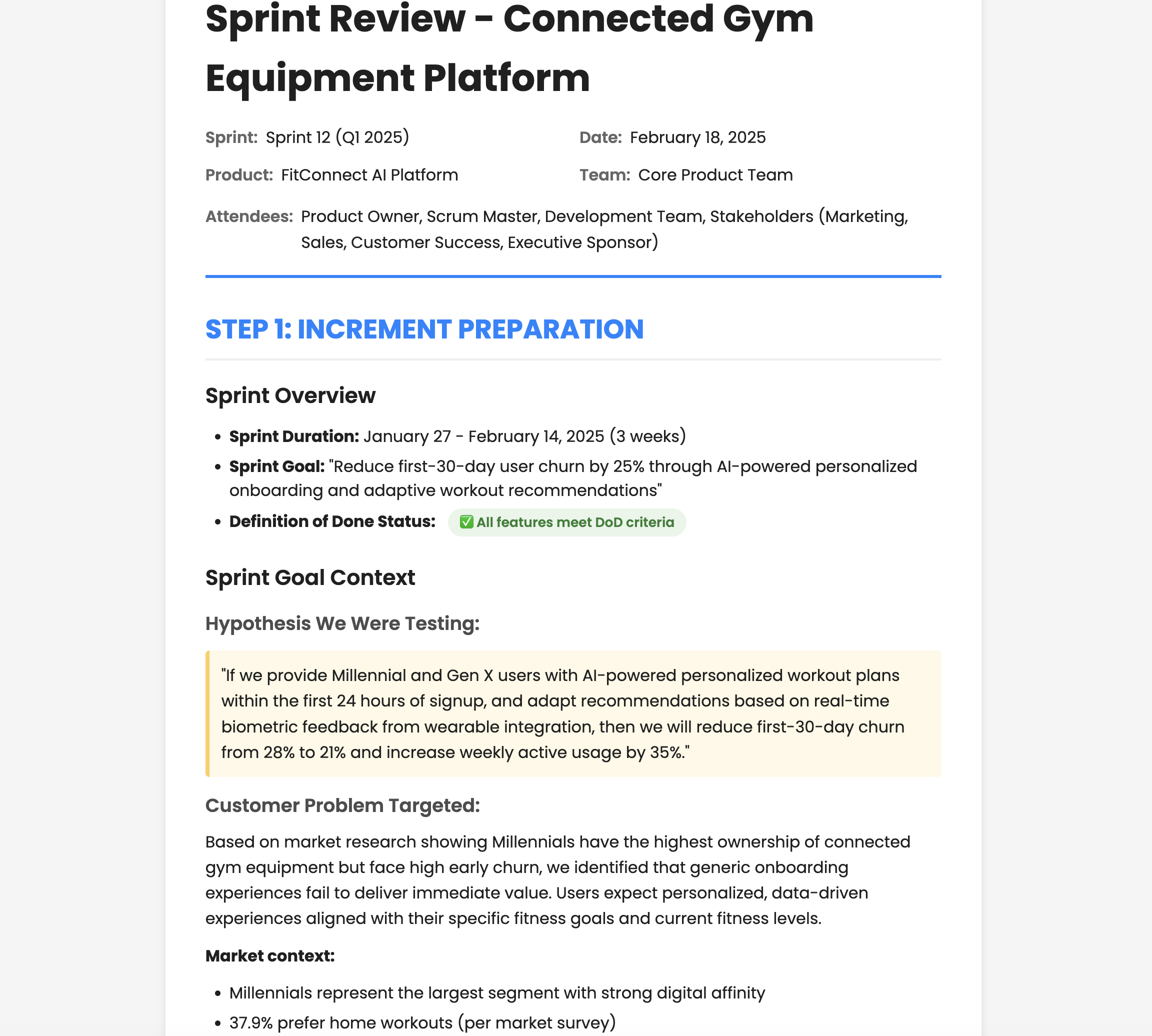
Preparation is not only about ensuring that features are complete. It is about preparing the story of the sprint.
Before the review, the team should confirm that all work being presented meets the Definition of Done. Incomplete or unstable features should not be showcased under the banner of progress, as this reduces credibility and shifts discussion toward technical debt rather than value delivery.
Equally important is preparing the narrative context:
- What sprint goal was set?
- What hypothesis were we testing?
- What customer or business problem were we targeting?
- What constraints shaped our decisions?
Stakeholders do not only need to see functionality; they need to understand intent. A well-prepared sprint review frames the increment as a logical outcome of strategic priorities rather than a collection of tasks.
This narrative preparation transforms the meeting from “show and tell” into a structured product learning session.
Step 2: Reconnect to the Sprint Goal and Broader Strategy
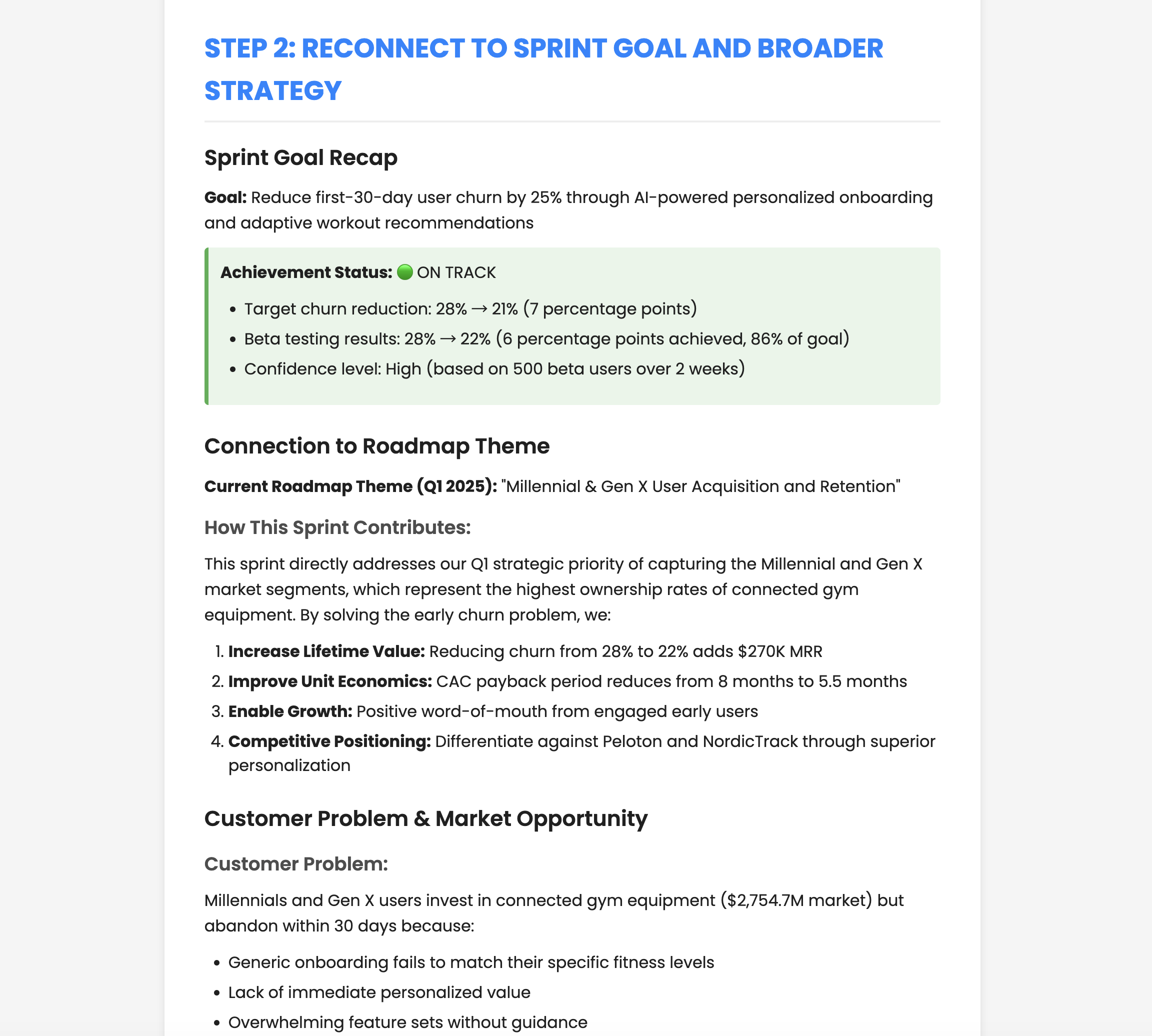
Begin the sprint review by re-grounding everyone in purpose.
Many sprint reviews fail because teams jump directly into demos without anchoring them in strategy. Instead, the session should start with a concise recap:
- What was the sprint goal?
- How does this sprint contribute to the current roadmap theme?
- Which customer problem or opportunity does this address?
This framing accomplishes two critical things.
First, it aligns stakeholder expectations. Participants know what they are evaluating and why it matters.
Second, it shifts feedback from surface-level reactions (“This button could be bigger”) to outcome-driven discussion (“Does this flow reduce onboarding friction as intended?”).
When sprint reviews consistently reinforce strategy, they strengthen lifecycle continuity across sprints rather than treating each iteration as isolated work.
Step 3: Demonstrate Real User Value, Not Just Features
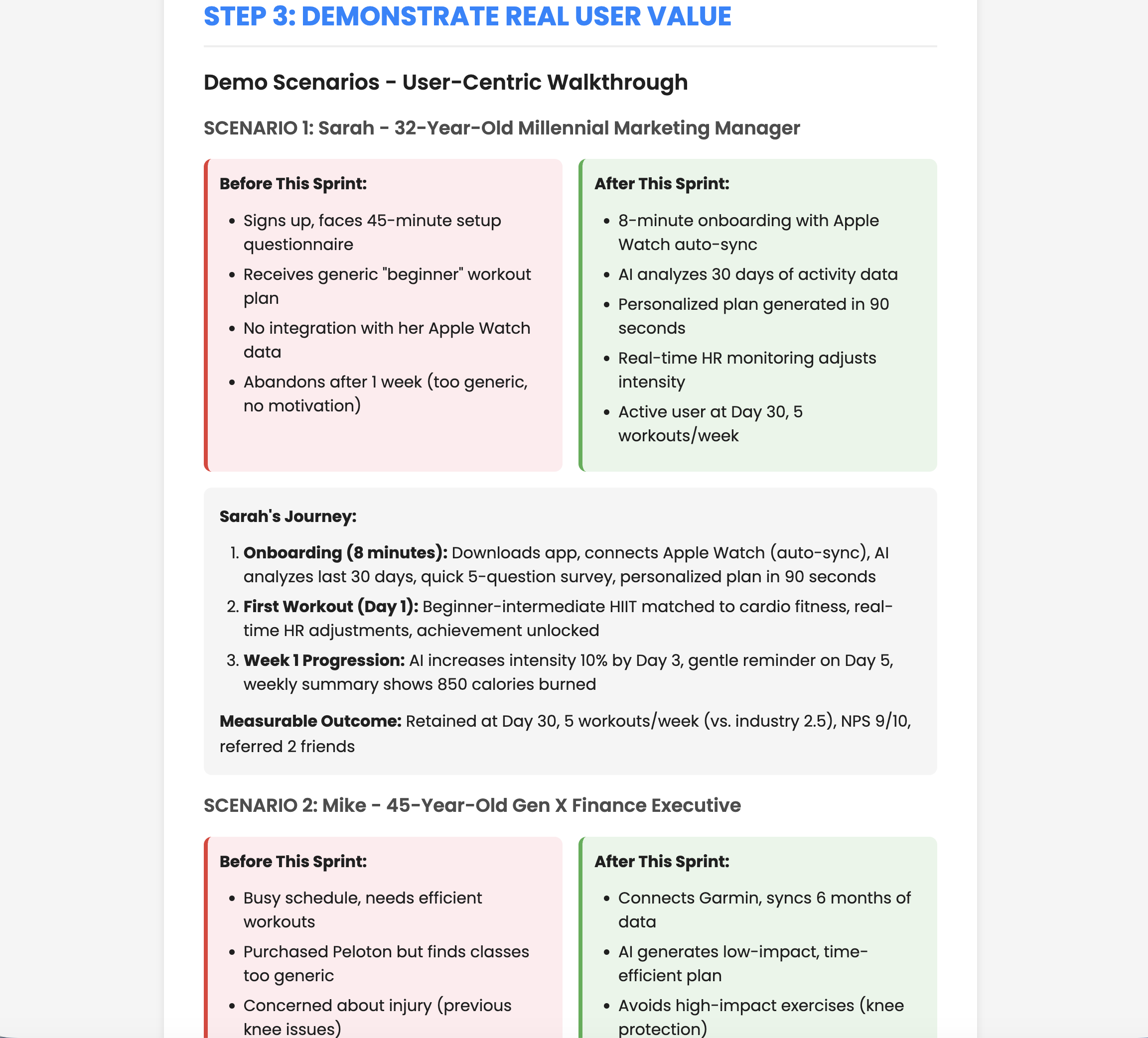
The demo portion of a sprint review should simulate real usage scenarios.
Instead of walking through technical implementation or listing completed tickets, the team should present the increment through the lens of user experience. Show how the user interacts with the feature. Highlight the before-and-after impact. If relevant, connect the feature to measurable outcomes (conversion, engagement, time savings, etc.).
A strong demo:
- Focuses on problems solved rather than components built
- Avoids internal jargon
- Makes tradeoffs transparent
- Acknowledges known limitations
When stakeholders see the feature in action within a real context, feedback becomes more meaningful and actionable.
Importantly, this is not a performance evaluation. It is an inspection moment. The team is inviting critique in order to improve product direction—not to defend implementation decisions.
Step 4: Facilitate Structured, High-Quality Feedback
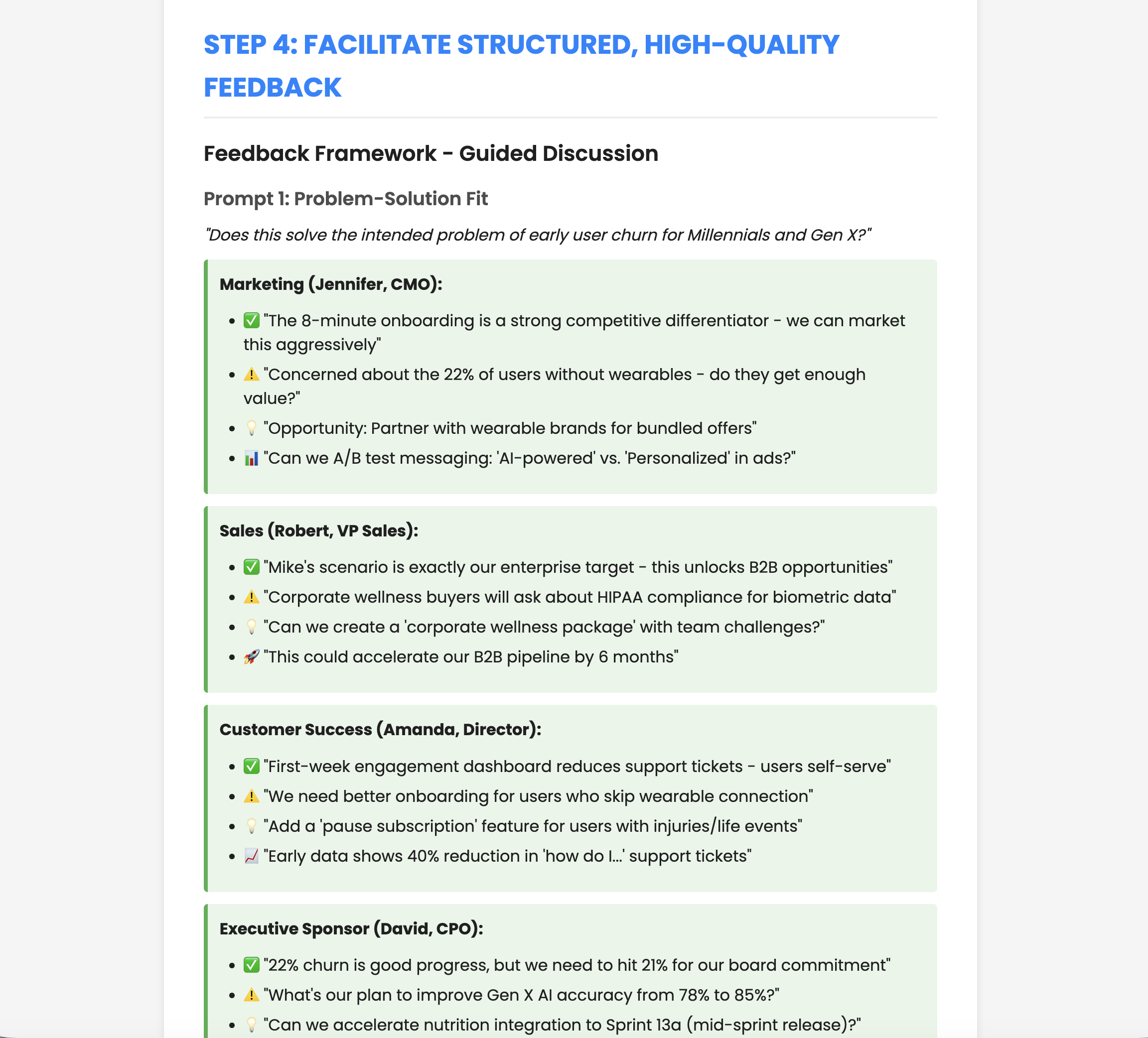
After the demo, the sprint review shifts from presentation to conversation.
Unstructured feedback often leads to silence or superficial comments. Instead of asking, “Any thoughts?”, guide stakeholders with targeted prompts:
- Does this solve the intended problem?
- Are there edge cases or risks we may be overlooking?
- Does this affect go-to-market timing or positioning?
- Are there regulatory, operational, or integration concerns?
- What assumptions should we revisit?
Encourage cross-functional perspectives. Marketing may notice positioning gaps. Sales may raise objections customers are likely to have. Support may identify usability concerns.
Capture feedback in real time. Visible documentation builds trust and ensures feedback does not disappear after the meeting.
A productive sprint review is measured not by how smooth the demo feels, but by how honest and constructive the dialogue becomes.
Step 5: Connect Feedback to Backlog and Roadmap Implications
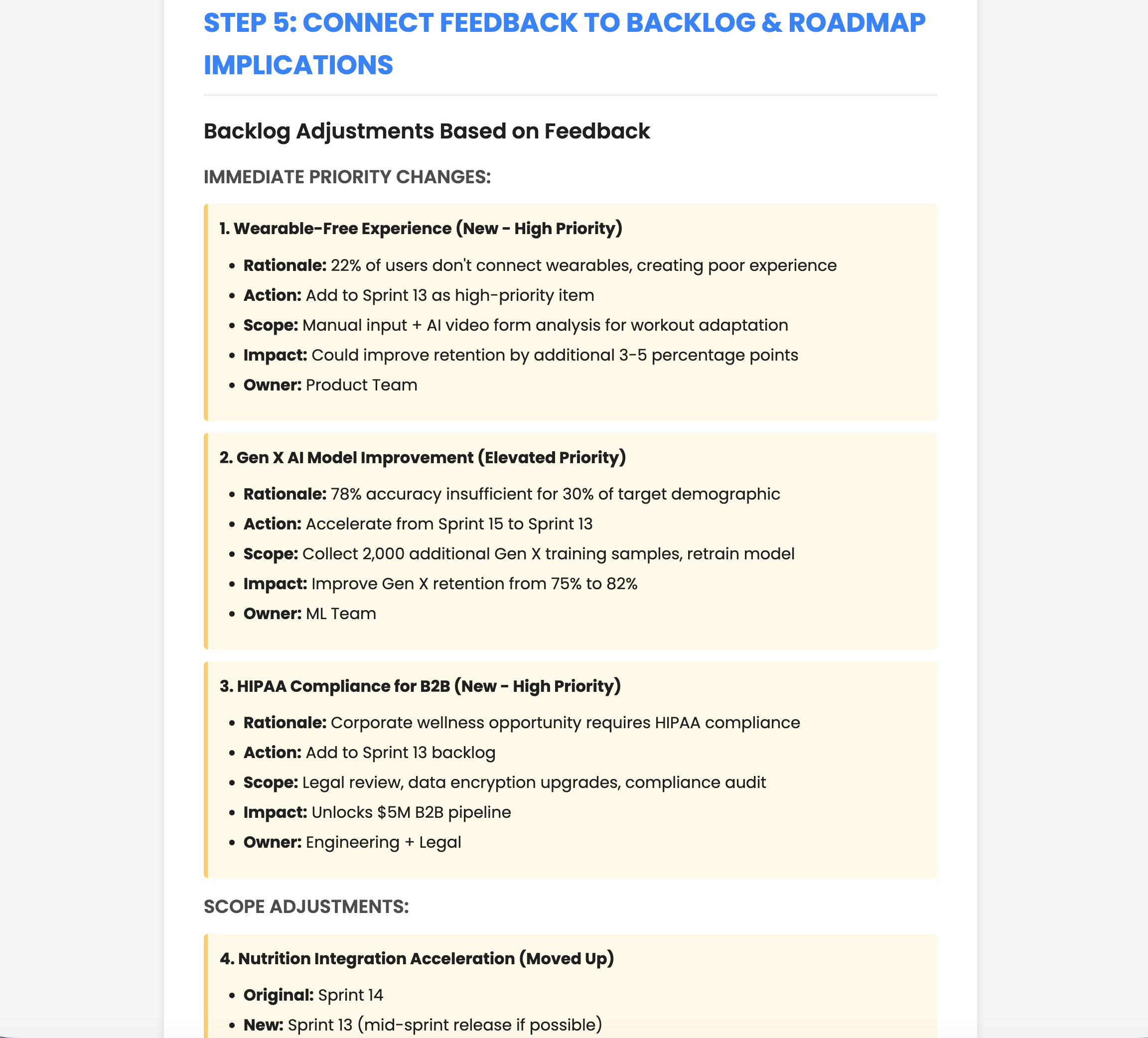
One of the most overlooked aspects of sprint reviews is strategic adaptation.
The sprint review should explicitly answer:
- Does this feedback change our priorities?
- Do we need to adjust scope?
- Should we accelerate or delay certain initiatives?
- Are there new risks or opportunities emerging?
If the sprint review ends without connecting insights to backlog adjustments or roadmap implications, its strategic value is diminished.
This step reinforces that agile is not just iterative development—it is iterative decision-making.
Over time, this habit ensures that sprint work continuously aligns with evolving market conditions and organizational strategy.
Step 6: Clarify Decisions, Ownership, and Next Steps
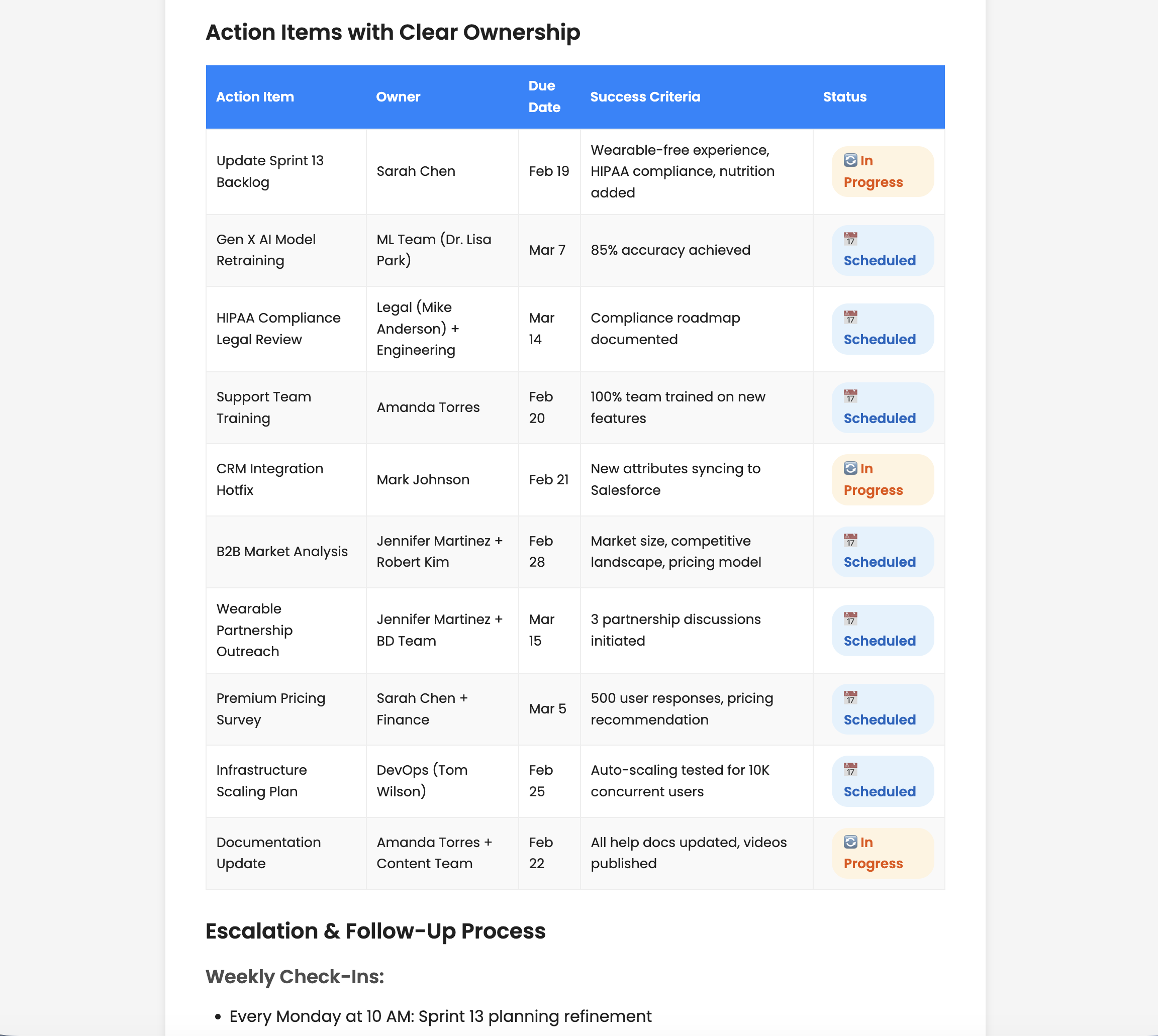
A sprint review should never end ambiguously.
Before closing, summarize:
- What feedback will be incorporated immediately
- What feedback requires further analysis
- What remains unchanged
- Who is responsible for follow-up
Ambiguity is one of the primary reasons sprint reviews lose credibility. Clear decision summaries ensure alignment persists beyond the meeting.
When teams consistently close sprint reviews with explicit decisions and direction, stakeholders begin to see them as reliable strategic checkpoints rather than ceremonial rituals.
Step 7: Preserve Knowledge for Future Lifecycle Stages
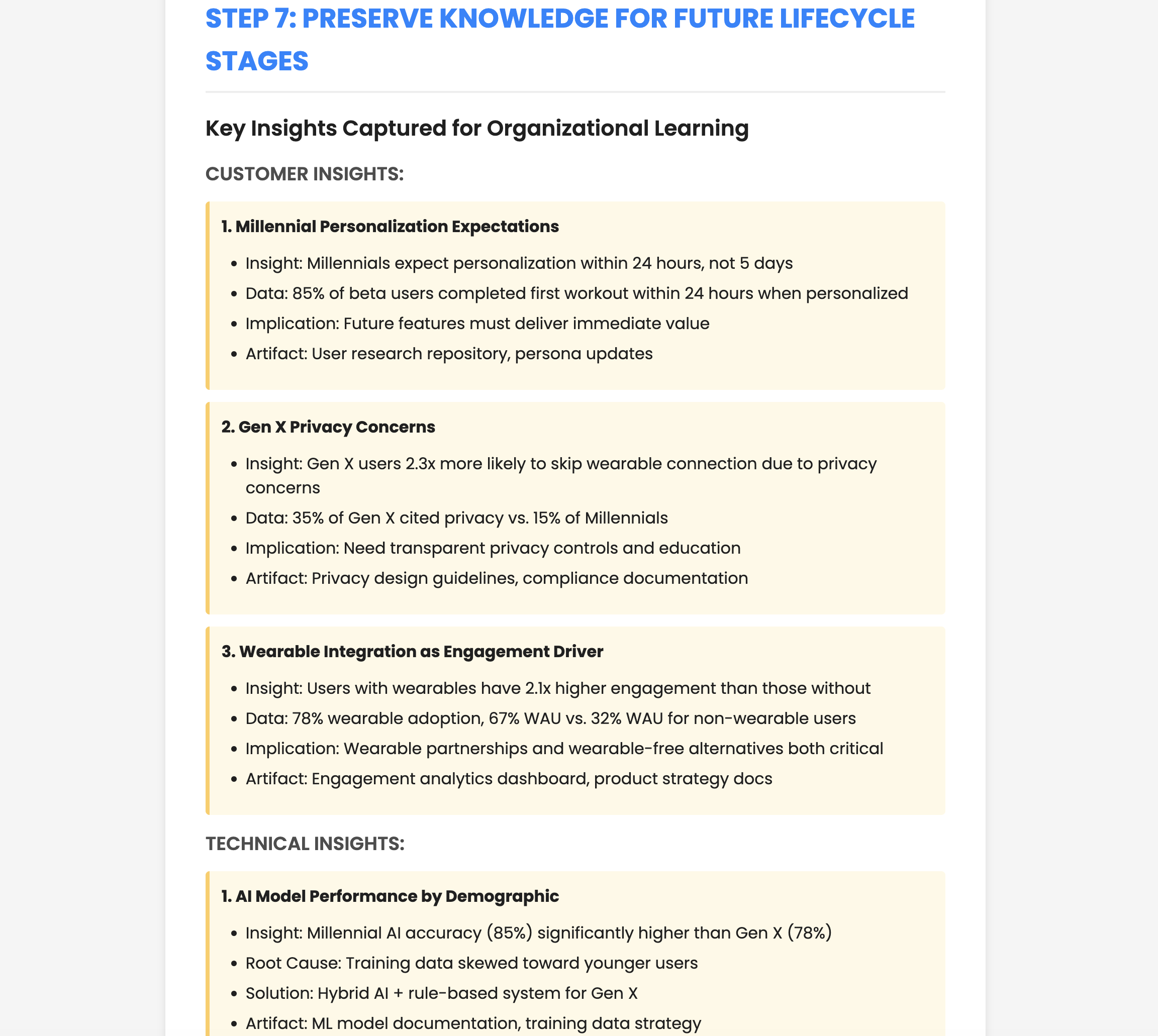
An often-missed opportunity in sprint reviews is long-term knowledge capture.
Sprint discussions contain valuable insights: customer reactions, tradeoff reasoning, assumptions validated or rejected. If this knowledge is not documented and connected to product artifacts, it is easily lost as teams move to the next sprint.
This is where integrating sprint reviews into a broader PLM system becomes critical. Capturing context ensures that future product decisions are informed by historical insight rather than repeated rediscovery.
A mature sprint review process contributes not only to immediate improvement—but to organizational learning across the entire product lifecycle.
How to Make Sprint Reviews More Efficient with Kuse
As products scale, sprint reviews often suffer from context loss. Notes, decisions, demos, and feedback become scattered across tools.
Kuse can serve as an intelligence layer within sprint workflows by:
1. Centralizing Sprint Knowledge
Upload PRDs, sprint goals, user stories, design files, and demo notes into a unified workspace. Kuse can synthesize context across documents, making preparation faster.
2. Auto-Generating Sprint Review Agendas
Use prompts such as:
“Generate a structured sprint review agenda based on these completed user stories and sprint goals. Include sections for demo, stakeholder feedback, and roadmap impact.”
This ensures consistency across reviews.
3. Summarizing Feedback into Actionable Items
After the meeting, paste discussion notes into Kuse and prompt:
“Summarize sprint review feedback and categorize it into: backlog updates, risks, product opportunities, and open questions.”
This reduces manual documentation effort.
4. Connecting Sprint Outcomes to Roadmap Themes
Kuse can analyze sprint outputs and map them to strategic initiatives, helping teams maintain lifecycle continuity.
In this way, sprint reviews evolve from isolated meetings into integrated product learning systems.
Conclusion
A sprint review is far more than a demo. It is a strategic checkpoint that aligns sprint execution with long-term product direction.
When structured effectively, sprint reviews:
- Improve transparency
- Strengthen stakeholder trust
- Accelerate learning
- Reduce roadmap drift
- Enhance lifecycle continuity
In modern product organizations, especially those integrating AI-enabled workflows, sprint reviews become even more powerful when supported by tools that preserve context and synthesize insights.
If sprint reviews feel repetitive or low-value in your organization, the problem is rarely the ceremony itself—it is the structure and intent behind it.
Reframe the sprint review as a product strategy conversation, and its value becomes immediately visible.