How to Make a Successful Product Launch Strategy in 2026
How to build a winning product launch strategy in 2026. Learn the difference between strategy and plan, key elements to include, real examples, and AI-powered workflows to launch smarter.
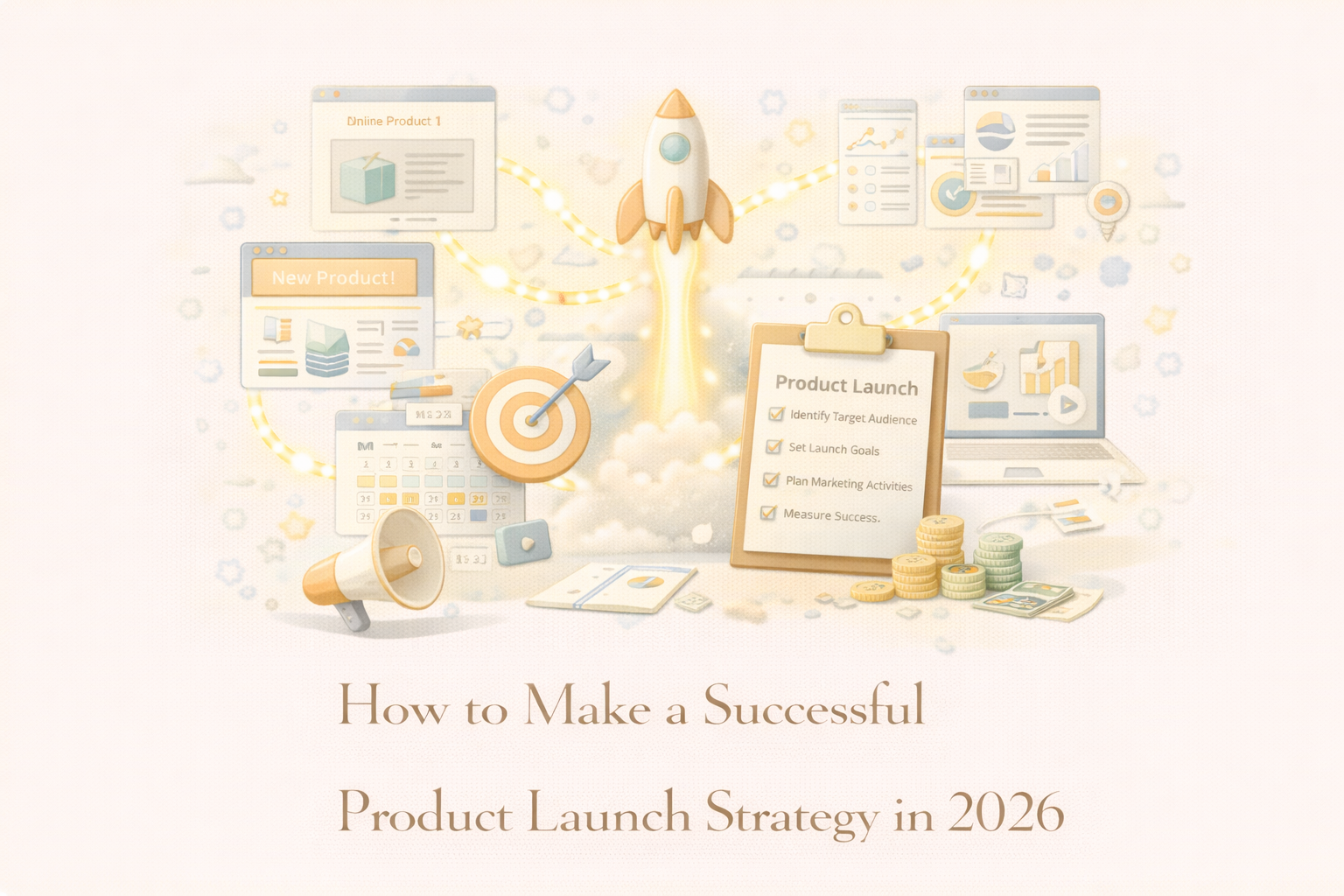
Launching a product in 2026 is fundamentally different from launching one five years ago.
Markets move faster. Customer feedback spreads instantly. AI accelerates competitor response. And product complexity—especially across SaaS, AI-enabled tools, and hybrid offerings—has increased dramatically.
A product launch is no longer a one-day event. It is a coordinated lifecycle moment where product, marketing, sales, support, operations, and leadership converge. When executed well, it compounds momentum. When misaligned, it exposes strategic gaps.
This guide explains what a product launch strategy truly is, how it differs from a launch plan, what elements it must include in 2026, and how modern teams can build and automate it effectively.
What Is a Product Launch Strategy?
A product launch strategy is a high-level framework that defines why, how, and to whom a product will be introduced to the market.
It answers strategic questions such as:
- What positioning will differentiate this product?
- Which target segments are prioritized?
- What core value narrative will resonate?
- What competitive context shapes the timing?
- What metrics define success?
Unlike execution checklists, a launch strategy establishes intent and direction. It aligns stakeholders before tactical tasks begin.
In lifecycle terms, a product launch strategy connects:
- Discovery insights
- Product positioning
- Go-to-market sequencing
- Post-launch measurement
Without strategy, launches become activity-heavy but directionless.
Why Is a Product Launch Strategy Important?
A product launch is often the most visible phase in the product lifecycle. It compresses months of development into a narrow window of market exposure.
A strong launch strategy matters because:
It Aligns Cross-Functional Teams
Product, marketing, sales, customer success, and support must share a unified narrative. If the strategy is unclear, teams default to their own interpretations, leading to inconsistent messaging and fragmented execution.
It Protects Market Positioning
The first framing customers encounter often defines long-term perception. A well-crafted launch strategy clarifies positioning against competitors and prevents reactive messaging.
It Reduces Execution Waste
Many launches fail not because the product is weak, but because resources are spent on channels or segments that were never strategically validated. Strategy filters noise before effort begins.
It Creates Measurable Accountability
A strategic framework defines success metrics in advance. This allows teams to evaluate performance objectively rather than relying on anecdotal impressions.
In 2026, where digital feedback cycles are near-instant, strategic clarity before launch is no longer optional—it is foundational.
Product Launch Strategy vs. Product Launch Plan
These two terms are often used interchangeably—but they are not the same.
A launch strategy determines market positioning, value proposition, and prioritization logic.
A launch plan operationalizes that strategy through campaigns, sales enablement, release notes, events, and deadlines.
If strategy defines the “north star,” the plan defines the route.
Without strategy, the plan becomes busywork. Without planning, strategy never materializes.
How to Write a Successful Product Launch Strategy (Step-by-Step)
A successful product launch strategy is not a marketing checklist. It is a structured decision framework that aligns positioning, audience targeting, internal readiness, and post-launch learning before execution begins.
In 2026, where AI accelerates competitor response and customer feedback spreads instantly, launch strategies must be precise, intentional, and adaptive.
Below is a detailed framework for building one properly.
Step 1: Clarify the Core Value Proposition
Every launch strategy begins with a disciplined articulation of value.
This is not a slogan. It is a structured answer to three interconnected questions:
- What specific problem are we solving?
- For whom does this problem matter most?
- Why are we uniquely positioned to solve it better than alternatives?
Many launches fail because teams describe features instead of outcomes. A value proposition should translate functionality into impact. Instead of stating what the product does, articulate what changes for the user after adoption.
For example, rather than “AI-powered analytics dashboard,” the value might be framed as:
“Reduces reporting preparation time by 60% for growth teams managing multi-channel campaigns.”
In this step, teams should synthesize research, interviews, and competitive insight into a single coherent positioning thesis. That thesis becomes the foundation for all downstream messaging and launch materials.
Without a sharply defined value proposition, every subsequent strategic decision becomes blurred.
Step 2: Define Target Segments and Prioritization Logic
Not every potential customer should be targeted equally at launch.
A strong launch strategy explicitly defines who the initial momentum is for. This requires thoughtful segmentation beyond demographics.
In 2026, segmentation should consider:
- Behavioral readiness (who already experiences acute pain?)
- Budget authority and adoption velocity
- Strategic influence (who shapes broader market perception?)
- Network effects (who amplifies visibility?)
Early adopters are not always the largest revenue segment—but they are often the most influential. Strategic prioritization means selecting segments where product-market fit is strongest, feedback loops are fastest, and early wins are achievable.
This stage should produce a clear prioritization statement such as:
“Initial launch focus: mid-sized SaaS companies with dedicated RevOps teams and multi-channel reporting complexity.”
That clarity guides channel selection, messaging tone, and enablement priorities.
Without segmentation discipline, launch messaging becomes generic—and generic messaging rarely converts.
Step 3: Analyze Competitive Context and Market Timing
No product launches in isolation. Competitive context shapes perception immediately.
A robust launch strategy includes an explicit competitive positioning narrative:
- Who are we compared against?
- Where do we overlap?
- Where do we differentiate?
- What trade-offs are we making intentionally?
This is not about attacking competitors. It is about defining mental categories. Customers instinctively compare new products against known alternatives. If you do not define the comparison frame, the market will define it for you.
Additionally, timing analysis matters. Consider:
- Are competitors releasing adjacent features?
- Is the category expanding or contracting?
- Are there regulatory or seasonal considerations?
- Is customer budget planning aligned with launch timing?
Strategic awareness here reduces reactive repositioning after launch.
Step 4: Craft a Cohesive Positioning and Messaging Architecture
A product launch strategy must convert the value proposition into a structured messaging hierarchy.
This architecture should include:
- A single core positioning statement
- Three to four benefit pillars
- Supporting proof points (data, case studies, validation signals)
- Audience-specific adaptations
Rather than creating dozens of disconnected taglines, the strategy should define a messaging spine that can be adapted consistently across channels.
For example:
- Executive messaging emphasizes ROI and strategic leverage.
- Technical messaging emphasizes architecture, scalability, and integration.
- End-user messaging emphasizes usability and workflow improvement.
The goal is narrative coherence across stakeholders.
A launch without messaging architecture often results in inconsistent sales decks, website copy, and enablement materials—weakening credibility.
Step 5: Define Success Metrics Before Execution Begins
Measurement discipline separates strategic launches from activity-driven launches.
Before any campaign begins, teams should define:
- Leading indicators (early adoption, demo requests, activation rates)
- Lagging indicators (revenue, retention, expansion)
- Behavioral milestones (time-to-first-value, feature engagement)
Success metrics should map directly to the product’s strategic objective. For example:
- If the goal is category expansion → focus on awareness and engagement.
- If the goal is revenue acceleration → focus on pipeline contribution and conversion.
- If the goal is retention improvement → focus on adoption and satisfaction metrics.
Clear measurement frameworks prevent post-launch narrative distortion. Without predefined metrics, teams often reinterpret outcomes to justify effort.
Strategic launches define success before exposure.
Step 6: Align Internal Enablement and Operational Readiness
One of the most underestimated aspects of launch strategy is internal clarity.
A product launch is a cross-functional moment. If internal teams lack understanding or readiness, external messaging collapses under pressure.
A thorough strategy must address:
- Sales enablement materials and objection handling
- Support readiness and documentation
- Onboarding experience alignment
- Executive communication clarity
- Customer success education
This step requires reviewing the product not just as a feature set, but as an operational system. Are processes ready? Are escalation paths clear? Are FAQs anticipated?
In 2026, where customer sentiment spreads quickly online, internal confusion surfaces externally within days.
Strategic alignment minimizes that risk.
Step 7: Build Structured Feedback Loops Into the Strategy
A modern launch is not a one-time event—it is an inflection point in a continuous lifecycle.
Therefore, launch strategy must include a feedback and iteration plan.
This involves defining:
- Where feedback will be collected (support channels, analytics, surveys)
- How signals will be synthesized
- Who reviews insights
- What thresholds trigger adjustments
AI tools increasingly help synthesize post-launch feedback at scale, but strategic intent must guide interpretation.
The most effective launches treat early feedback as data, not as validation or failure.
Iteration planning ensures the launch evolves intelligently rather than reactively.
Step 8: Document Assumptions and Strategic Hypotheses
Every launch is built on assumptions:
- Customers value feature X more than Y.
- Segment A will convert faster than Segment B.
- Messaging angle M resonates more than N.
Instead of hiding these assumptions, document them explicitly. Treat them as testable hypotheses.
This allows teams to:
- Validate quickly
- Adjust deliberately
- Preserve learning for future launches
When assumptions remain implicit, misalignment becomes invisible.
When assumptions are explicit, learning compounds.
How to Build a Product Launch Strategy More Efficiently with Kuse
In complex product environments, the hardest part of launch strategy is knowledge consolidation.
Teams must synthesize:
- PRDs
- Competitor analysis
- User research
- Roadmaps
- Feedback data
- Sales input
Kuse enables structured aggregation and synthesis.
Automated Workflow in Kuse
1. Upload all lifecycle documents (PRDs, research, competitor analysis, roadmap).
2. Ask Kuse to synthesize positioning:
“Analyze these materials and draft a cohesive product launch strategy including target segments, differentiation, key messaging pillars, and success metrics.”
3. Generate audience-specific narratives:
“Rewrite the positioning for enterprise buyers and technical evaluators.”
4. Create aligned launch briefs:
“Create a go-to-market launch brief for marketing and sales enablement.”
5. Maintain ongoing updates as feedback arrives.
Instead of recreating context in meetings, teams operate from shared intelligence.
Conclusion
In 2026, successful product launches are not about louder marketing—they are about sharper alignment.
A strong product launch strategy:
- Preserves lifecycle continuity
- Aligns cross-functional execution
- Protects positioning clarity
- Enables measurable learning
AI-enhanced workflows now allow teams to synthesize complexity faster than ever before. But strategic thinking remains human.
Launches succeed when clarity precedes activity.